
By Richard Booth, OKC Facts contributor
Originally published on November 24, 2022 | Updated with new documents September 2026
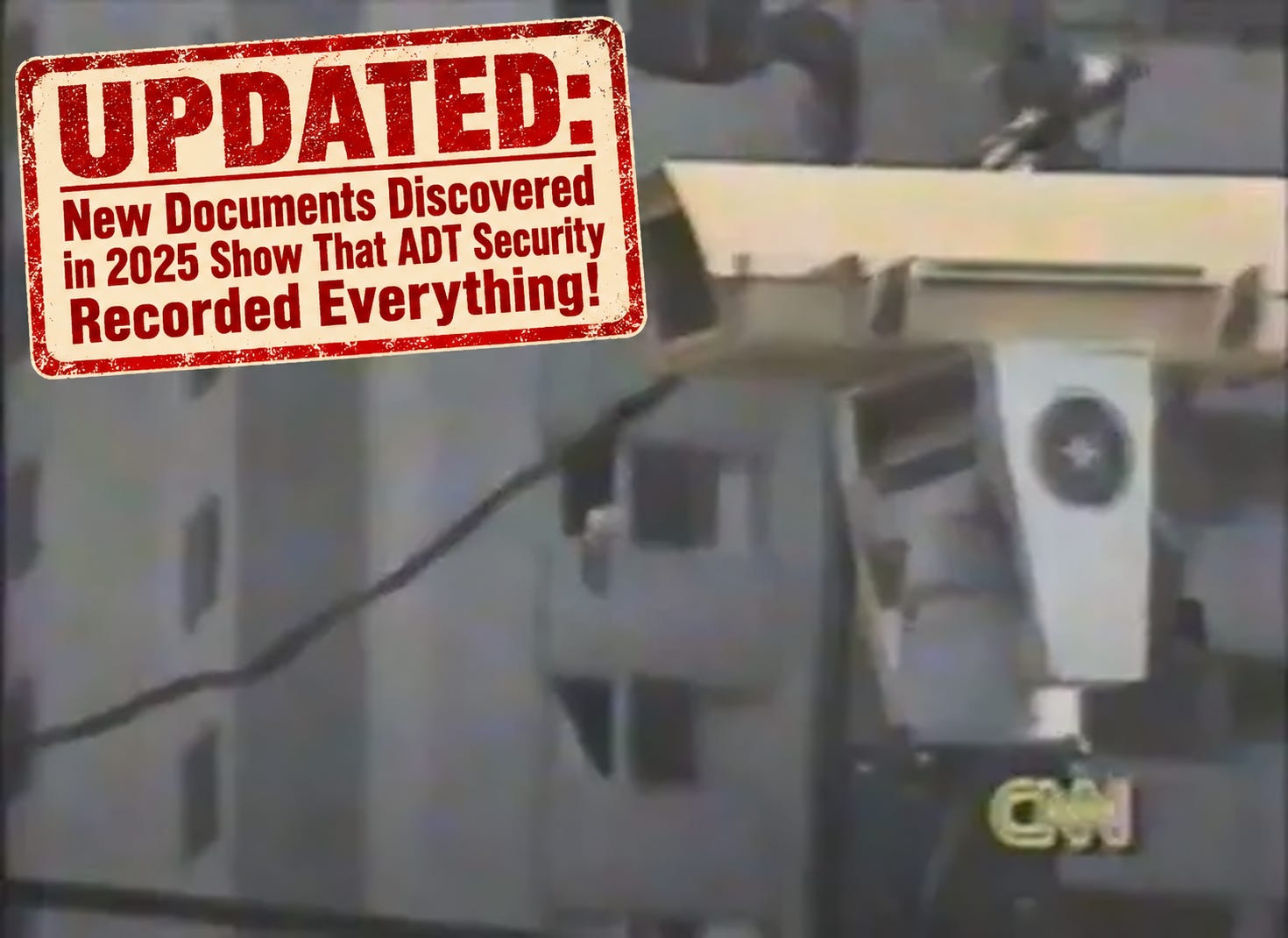
“All they showed us were a series of video still photographs showing the Ryder truck, but no one in or around the vehicle. We were never allowed to see the photo evidence from the cameras on the Murrah Building, that would have shown the truck being parked and the people who got out of the truck. That’s all on tape. And we were authorized to see all of that. But we weren’t allowed to see it… and in fact, nobody has been allowed to see it.”
— Federal Grand Juror Hoppy Heidelberg on the surveillance footage
In today’s world, the urban landscape is saturated with surveillance cameras: you can’t go anywhere without being recorded, whether by the city’s cameras mounted on traffic lights or by cameras on private property. Even in neighborhoods, just passing through, you’re likely to be filmed by dozens—if not more—of Ring doorbell cameras.
Thirty-plus years ago, in 1995, it was not that way. The surveillance state was still in its infancy. Even so, by then, most large metropolitan cities did have clusters of surveillance cameras on government and private property. Video quality was generally lower than it is today, with resolutions such as 480p; sometimes recordings were time-lapse, sometimes black-and-white, or both.
Despite these technical limitations, security cameras were still present and highly valuable to law enforcement investigations.
On the morning of April 19th, 1995, security cameras were located at more than a dozen sites in downtown Oklahoma City, including the Regency Towers apartment building, the Journal-Record Building, the Southwestern Bell building, the U.S. Post Office, and several other key locations.
FBI records show that some of these cameras captured footage of significant evidentiary value, and some records identify precisely which cameras captured the bombers and/or their vehicles that morning. These records, along with newspaper clippings and TV news segments, indicate that the bombing itself was captured on video, as was the perpetrators’ egress from the crime scene.
To date, only a select few have seen the surveillance footage, though records indicate that representatives from the FBI and Dateline: NBC have reviewed it. The public has not been shown this video, nor have the grand jurors or jurors at either the McVeigh or Nichols trials. We must ask: why?
The first reports concerning surveillance camera footage were aired on CNN within days of the bombing. One early CNN report said that “the FBI says that it has surveillance camera video of the bomb site,” which was then followed by a clip of FBI on-scene commander Weldon Kennedy urging all businesses in the area to come forward to provide their security camera recordings, which they did.
Later that same week, CNN further reported that “the FBI says that it has obtained videotapes from security cameras in the vicinity of the blast and may have tape of the Ryder rental truck used to house the enormous bomb.”
Note that in CNN’s second broadcast about the tapes, the network reported that the FBI had “videotapes,” plural, and referenced “security cameras,” plural, implying that more than one recording had been obtained.
FBI investigatory records, court transcripts, and even testimony under oath by an FBI agent assigned to the case confirm this.
Indeed, just eight days after the bombing, a preliminary hearing held in the U.S. District Court for the Western District of Oklahoma sheds considerable light on the FBI’s evidence in the case, to include both eyewitnesses and the crucial surveillance camera recordings.
The Preliminary Hearing
By the April 27th, 1995, preliminary hearing, the primary suspect — Timothy McVeigh — was in custody. The purpose of the preliminary hearing was to show probable cause and a reasonable basis for proceeding in the case of the United States of America vs. Timothy James McVeigh. Leading the charge in the government’s case at the preliminary hearing was principal Associate Deputy Attorney General Merrick Garland, a top aide to Deputy Attorney General Jamie Gorelick.
Garland’s chief witness at the hearing was FBI Special Agent Jon Hersley, who later testified that the FBI had multiple surveillance camera recordings in its possession at the time.
During the hearing, Special Agent Hersley testified that he had seen both video and still-image video frames from surveillance recordings seized by the FBI. For example, Hersley testified that one photo he saw depicted a Ryder truck moving east on 5th Street. That photo came from a surveillance camera mounted on the Regency Towers apartment complex. Regency Towers was located less than a block from the Murrah Building and had an unobstructed view of the building’s north face—precisely where the bomb truck was parked.
Hersley’s testimony is worth citing here because it is so specific about footage the FBI seized during its investigation. To read the full transcript, click here.
MR. COYLE: So you say there is film available that shows the — a Ryder Truck in an easterly direction, that is traveling in an easterly direction on Fifth Street?
MR. HERSLEY: Yes.
MR. COYLE: Is it past the street that we know as Harvey?
MR. HERSLEY: I am not — I have not studied that film in detail. It’s in that general vicinity right in there. It may be the video that I saw. I believe it is just before — well, I am not sure. I better not say that.
MR. COYLE: Well, Harvey Street —
MR. HERSLEY: I don’t know. [[ Agent Hersley was awful quick to respond “I don’t know” — before even being asked a question—and right after he said “I better not say that.” Better not say what, Jon? ]]
MR. COYLE: Harvey Street is the street that is immediately west of the Murrah Building?
MR. HERSLEY: That is correct.
MR. COYLE: Are the photographs that you saw or, is it still photo or film?
MR. HERSLEY: What I saw was the still photos.
MR. COYLE: Is it a still photo that has been removed from a film?
MR. HERSLEY: Yes.
MR. COYLE: So it was a close-up more of the truck than its location?
MR. HERSLEY: It wasn’t a close-up photo, it was taken from a camera off one of the buildings in the vicinity.
MR. COYLE: Did you make a determination of what building it came off of?
MR. HERSLEY: No, I did not myself.
MR. COYLE: Okay, did anyone?
MR. HERSLEY: I believe one of the other agents was able to determine that it came from one — one of the films came from the Regency Tower Apartments.
MR. COYLE: Was there a time indicated on the picture of the film that you saw?
MR. HERSLEY: Yeah.
Agent Hersley’s testimony clarifies that the FBI had multiple surveillance camera recordings from the area. When Hersley testified that “one of the films came from the Regency Tower Apartments,” his use of the word “films,” plural, indicates there was more than one recording.
In addition to seeing photos taken from a surveillance video depicting a Ryder truck on 5th Street, Hersley testified that he had seen photos depicting another location: a parking lot next to the Journal Record Building.
Hersley testified at length about a key witness (Gary Lewis) who had seen Timothy McVeigh — and another suspect — speeding away from an alley adjacent to the Journal Record Building and that this vicinity was covered by the seized surveillance footage.
Hersley’s testimony concerning the Journal Record building and associated surveillance footage recordings was covered during the preliminary hearing—to varying degrees of specificity—and key portions are excerpted below:
MR. COYLE: Where did this witness see the yellow Mercury speeding away? [[ this witness is Gary Lewis -Editor ]]
MR. HERSLEY: Over in the direction — in the parking lot, in an area where the witness I had previously testified about said that the individual he identified as Mr. McVeigh was walking in a northerly direction towards.
MR. COYLE: Where is that parking lot, sir?
MR. HERSLEY: Over on the north side of Fifth Street, close to the Journal Record Building.
MR. COYLE: This particular male witness has indicated that he saw the — a yellow Mercury speeding away?
MR. HERSLEY: Yes.
MR. COYLE: Did this particular witness indicate to agents of the FBI how many persons were in the speeding yellow Mercury?
MR. HERSLEY: Two.
MR. COYLE: I assume speeding away on Fifth Street; is that correct?
MR. HERSLEY: Well, I think it is actually the alley area that would be immediately north of Fifth Street.
MR. COYLE: Immediately north of Fifth Street is a parking lot there. Are you talking about the —
MR. HERSLEY: The north side of that parking lot.
MR. COYLE: So the alley between the Journal Record Building and the parking lot? I’m sorry to interrupt you, I didn’t mean to.
Are you talking about that area, that alley?
MR. HERSLEY: I’m talking about the area on the north side of the parking lot that we have been speaking about.
MR. COYLE: That’s where you are telling the Court that the yellow Mercury was speeding through that particular alley?
MR. HERSLEY: Yes.
MR COYLE: In your review of the surveillance photos, did you find any surveillance photos of that parking lot across the street from the Murrah Building?
MR. HERSLEY: Yes.
MR. COYLE: Have you been shown a photograph of that particular parking lot, sir, across the street from the Murrah Building that includes the speeding Mercury in the photograph?
MR. HERSLEY: We don’t know for sure yet. Those photographs are not real clear. They are taken from a pretty good distance away. There appears to be a light-colored car in the very vicinity where this witness testifies — or provides the information was speeding away from. We are not able to determine yet if that is in fact the yellow Mercury.
MR. COYLE: The pictures that you saw of that particular parking lot — now I’m talking about the parking lot across the street from the Murrah Building — in a northerly direction, that parking lot, there is a film of that parking lot prior to the time of the explosion?
MR. HERSLEY: Yes.
MR. COYLE: Correct?
MR. HERSLEY: Yes.
MR. COYLE: Is it time-stamped so that you can tell a particular time of day on the 19th of April that that camera is viewing, scanning that parking lot?
MR. HERSLEY: Yes.
In addition to confirming that the FBI had in its possession surveillance camera footage, the preliminary hearing also makes it very clear that the FBI had multiple eyewitnesses to Timothy McVeigh — with an accomplice — in downtown Oklahoma City that morning. Agent Hersley’s testimony reflects this, and he testifies no fewer than three times that “our primary focus right now is to try to determine the identity and the location of the other subjects.”
Agent Hersley testifies at length concerning what eyewitnesses Gary Lewis, Rodney Johnson, Dena Hunt, and Mike Moroz all saw. All four of these witnesses saw McVeigh with another person in downtown Oklahoma City. One of them, mechanic Mike Moroz, picked McVeigh out of an FBI lineup in downtown Oklahoma City within days of the bombing.
Moroz saw and spoke to McVeigh up close, giving him directions from Johnny’s Tire about 20 minutes before the bombing. According to Moroz, a passenger was in the Ryder truck with McVeigh when he spoke to him that morning. That passenger has come to be known as John Doe #2.
The other suspect— John Doe #2 — has never been captured, and the FBI today denies that he even exists. As a result, the man’s identity remains controversial and has prompted much speculation. What can be said with certainty is that many witnesses observed Timothy McVeigh with another person in downtown Oklahoma City, and the surveillance footage of the bombing, described in the April 27th preliminary hearing, must depict that other suspect.
Fueling suspicion about this other suspect is the fact that Associate Deputy Attorney General Merrick Garland issued immediate objections during the preliminary hearing whenever direct questions were asked concerning either the surveillance camera footage or John Doe #2:
MR. COYLE: Who are those agents that are tasked with the responsibility of reviewing photographs and film footage?
MR. GARLAND: Objection, Your Honor. This is now purely speculative.
THE COURT: Overruled.
MR. HERSLEY: The agent that showed me the photographs was Walt Lamar.
MR. HERSLEY: I know there was at least one male that observed the Ryder Truck and the occupants of the Ryder Truck. That person also advised that the individual in the truck closely resembled the individual depicted in composite one.
MR. COYLE: Did you tell me he saw occupants of a Ryder Truck and there were more than one?
MR. GARLAND: Objection. The only person on trial at this hearing is Mr. McVeigh. It doesn’t matter whether there were two or a hundred people in that truck as long as there was somebody representing Mr. McVeigh there. It is discovery and totally outside the scope of this hearing.
THE COURT: Objection overruled. Go ahead.
MR. HERSLEY: This witness advised that there were two individuals in the truck. The individual resembling Mr. McVeigh was the driver.
None of the surveillance videos mentioned in the CNN broadcasts or at the April 27th preliminary hearing were shown at the McVeigh and Nichols federal trials in 1997 and 1998. It was as if they did not exist.
This made little sense — if the FBI had videotape showing McVeigh at the Murrah Building in Oklahoma City, getting out of the Ryder truck, that would constitute “best evidence” placing McVeigh at the scene of the crime. Eyewitnesses who saw McVeigh in downtown Oklahoma City would also be damning evidence.
It is therefore puzzling that neither the videotape recordings nor any of the eyewitnesses appeared at trial. Could this be because the surveillance tapes show that McVeigh was not alone, as every one of these witnesses who saw McVeigh reported: he was with another person, and that other person is still unaccounted for today?
Four years after the bombing, after Timothy McVeigh and Terry Nichols had both been convicted, the full scope of the FBI’s surveillance footage of the bombing emerged.
In 1999, a Freedom of Information Act lawsuit revealed that the FBI had taken possession of nearly two dozen recordings from surveillance cameras in downtown Oklahoma City.
FOIA Lawsuit Reveals: FBI Has Secret Footage
A 1999 Freedom of Information Act lawsuit filed by investigative journalist David Hoffman produced documents revealing that the FBI had twenty-three video surveillance recordings of the Murrah Building and surrounding area, with copies stored at the FBI’s Oklahoma City field office and, curiously, a single surveillance tape listed as being held under lock and key at FBI headquarters in Washington, D.C.

The central issue in Hoffman’s lawsuit was that the FBI had conceded the existence of the surveillance camera footage yet refused to release it in response to legitimate Freedom of Information Act (FOIA) requests.
During Hoffman’s FOIA suit, FBI lawyers filed multiple motions for summary judgment — essentially asking the judge to dismiss the case in their favor. Each subsequent motion filed by the Department of Justice cited entirely different reasons for withholding the material—seemingly coming up with new excuses each time. The judge summarily dismissed these motions, with increasing criticism of the FBI from presiding U.S. District Court Judge Wayne Alley.
Alley wrote that the FBI had offered insufficient “justifications for withholding all materials in its investigative files” and further stated that the FBI had exhibited “shoddy conduct” during the litigation.
Judge Alley wrote that “the court would be inclined” to compel the FBI to release the surveillance footage; however, he ultimately ruled he could not. A previous order issued by Judge Richard P. Matsch, presiding judge in the McVeigh and Nichols Federal trials, deemed that the surveillance camera footage from the bombing investigation was under seal. In contrast, the McVeigh and Nichols trial convictions were subject to appeal(s).
As a result, Judge Alley ruled that “the Court is presently powerless to grant plaintiff relief under FOIA” in view of Judge Matsch’s previous ruling and then-outstanding appeals.
Judge Alley would add, however, that Hoffman “raises a legitimate point” that the federal criminal case against bombers Timothy McVeigh and Terry Nichols was nearing an end, and thus Matsch’s order to seal the evidence would presumably expire as those cases and subsequent appeals ended.
Judge Alley spells out this position by writing that the FBI’s “justification for its shroud of secrecy may likewise soon end.”
The Trentadue FOIA Suit & Edited Recordings
Hoffman’s suit wouldn’t be the last time the FBI would face legal challenges over secret footage. The video recordings seized by the FBI during the OKC bombing investigation have once again become central to a legal battle. A FOIA lawsuit concerning the tapes is currently being litigated by Salt Lake City attorney Jesse Trentadue. The FBI sent Trentadue a batch of 30 recordings following a Freedom of Information Act request Trentadue filed. However, Trentadue noted that the footage the FBI produced was of little value — it shows absolutely nothing of interest. The FBI-released recordings show nothing at all just before the 9:02 AM blast. Jesse Trentadue says the tapes are clearly incomplete. “Four cameras in four different locations going blank at basically the same time on the morning of April 19, 1995? There ain’t no such thing as a coincidence,” Trentadue told the Associated Press after receiving the bizarrely incomplete footage.
For its part, the FBI preposterously claims that the security cameras failed to record the moments leading up to the blast because all of them had “run out of tape” or, improbably, because “the tape was being replaced” during the minutes immediately before the April 19th, 1995 bombing. Trentadue noted that “the interesting thing is [the tapes] spring back on after 9:02 AM” and that “the absence of footage from these crucial time intervals is evidence that there is something there that the FBI doesn’t want anybody to see.” Occam’s Razor thus suggests that the recordings, if released unredacted and without material alteration, would show something so contrary to the official narrative that it would undermine the public’s trust in the FBI, perhaps irrevocably.
The surveillance tapes released to Trentadue appear to be incomplete, and this can be reasonably demonstrated based on what has previously been written about the surveillance recordings in FBI and Secret Service documents from the bombing investigation.
These supporting documents were introduced as exhibits in Trentadue’s FOIA lawsuit, which is currently being litigated in Salt Lake City. Additional insight into what appears on the tapes comes from statements by FBI agents and law enforcement personnel who have reportedly seen the footage.
FBI and Secret Service Officials: We Had McVeigh on Tape
Danny Coulson was the FBI Special Agent in Charge of the Dallas Field Office and founder of the FBI’s Hostage Rescue Team (HRT). Coulson was one of the commanders in the OKC bombing investigation, in charge of the crime scene. In 1999, on a BookTV (C-SPAN) broadcast where agent Coulson is promoting his book No Heroes, Coulson says point blank, “we had the videotape of the truck being pulled up a couple minutes before nine” and that “we had him [McVeigh] on videotape.”
Supporting Coulson’s statement is a Secret Service timeline which states “security video shows the Ryder truck pulling up to the Federal Building then pausing (7–10 seconds) before resuming into a slot in front of the building.”
Yet another entry in the Secret Service timeline says that “security video tapes from the area show the truck detonation 3 minutes and 6 seconds after the suspects exited the truck.”
The use of the word “suspects,” plural, indicates that the footage shows more than one person exiting the Ryder truck. The Secret Service timeline also shows a startling degree of specificity — “3 minutes and 6 seconds after the suspects exited the truck” strongly suggests the footage was time-coded or could otherwise be used to measure the passage of time relative to what appears on the footage.
Additionally, FBI SA Pamela Matson produced an FBI inventory log of seized surveillance camera footage, reviewing all footage for anything deemed “positive” in terms of evidentiary value. That inventory log denotes two recordings as “positive” — that is, they show the bombing, the suspects, and/or the suspects’ vehicles.
Those two recordings are footage from the Journal Record Building and the Southwestern Bell building. Both security cameras denoted in the FBI evidence log as having recorded footage deemed positive were positioned in areas where key eyewitnesses described seeing Timothy McVeigh and other suspects in the moments before and after the blast, so we can guess by their testimony what those recordings might show.
For example, witness Gary Lewis told the FBI that he observed Timothy McVeigh and another man in a Mercury Marquis speeding past the Journal Record building moments before the blast, and what he saw would presumably appear on the Journal Record building tape deemed positive.
Similarly, witness Germaine Johnston told the FBI that she spotted McVeigh and another man standing next to the Mercury Marquis in an alley adjacent to the Southwestern Bell building following the blast. Cameras on the Southwestern Bell property likely recorded the ingress and egress points, capturing the bombers or their escape. Likewise, surveillance cameras trained on 5th Street would have captured the delivery of the Ryder truck bomb--as described by Agent Coulson, thus showing what was described in such specific detail in the Secret Service timeline.
News Reports Cite Law Enforcement: Passenger Appears on Tapes
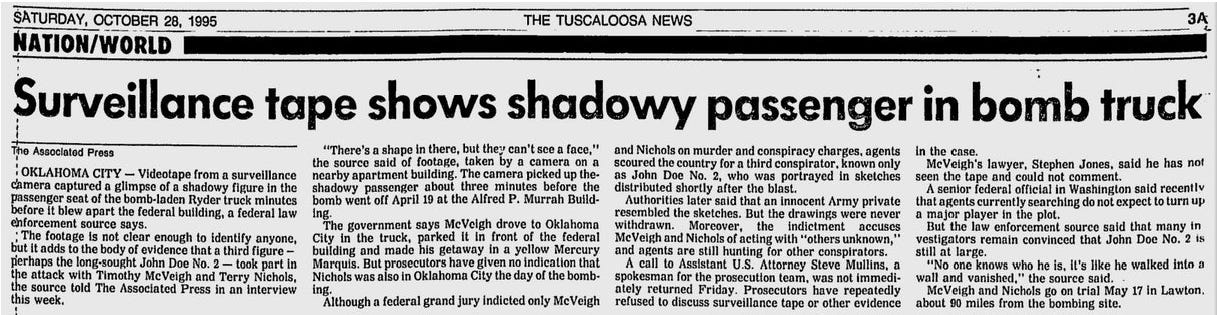
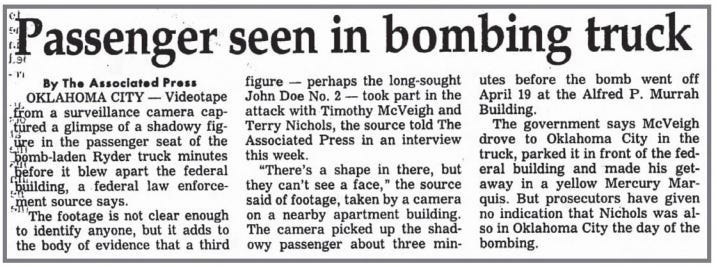
In addition to the FBI evidence log and Secret Service timeline, there are news media accounts published months after the bombing where law enforcement sources familiar with the recordings describe what appears on the footage.
An October 28th, 1995, Associated Press report that ran nationwide, headlined “Surveillance Tape Shows Shadowy Passenger in Bomb Truck,” quoted one law enforcement official stating that the surveillance footage shows a passenger in the Ryder truck with McVeigh.
The article identified the source of that footage as a security camera mounted on a nearby apartment building. That camera is most certainly from the Regency Towers apartment building, cited by FBI agent Hersley in the April 27th, 1995, preliminary hearing.
Yet other news reports from the time describe surveillance recordings that captured vehicles associated with the bombing. This report, for example, says that Timothy McVeigh’s license plate was captured on another vehicle fleeing the scene:
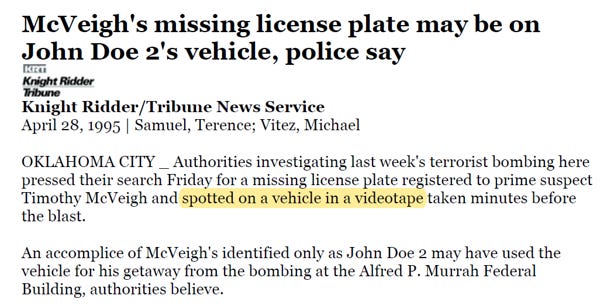
ADT Security and The Regency Towers Footage: The Smoking Gun
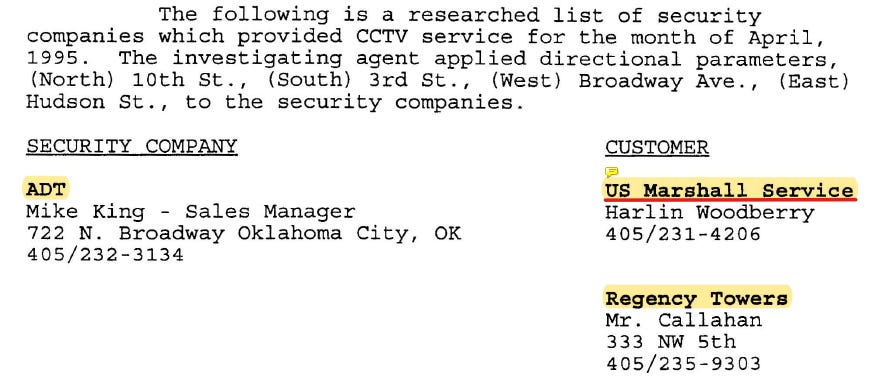
FBI documents reveal that the Regency Towers apartment complex had multiple surveillance cameras, which ADT Security in downtown Oklahoma City serviced and maintained.
Documents also indicate that ADT Security provided service and maintenance for the cameras at the Murrah Federal Building, under an account managed by the U.S. Marshals Service.
Find below excerpts from documents uncovered in 2025 by researcher Richard Booth:

A declaration from security professional Joe Bradford Cooley, introduced in Jesse Trentadue’s FOIA lawsuit, details Cooley’s early 1995 site tour of the Murrah building’s security system with Thomas Hunt, head of the Federal Protective Service. Cooley was shown the room housing the VCRs that recorded the Murrah building’s security cameras, and he was briefed on ADT Security’s maintenance of the cameras and CCTV feed(s). His declaration indicates that the cameras provided a closed-circuit feed, with footage recorded on-site at the Murrah building and simulcast to ADT Security downtown, where it was also recorded. See Cooley’s declaration for full details, here. It is worth noting that FBI agents used ladders to climb up and physically remove the external cameras from the Murrah building that day: why did agents physically remove the exterior cameras, if those cameras were recorded by both VCRs at the Murrah building in the Marshal’s surveillance and security room, and also at ADT Security downtown via CCTV? What were they hiding?
FBI documents uncovered by Richard Booth make it clear that ADT Security turned over all its recordings to the FBI. From this, we know that the FBI would have had both the tape from the Regency Towers apartments recovered by OKC PD officer Ritch Willis and handed over to FBI SA Lou Ann Sandstrom, and any additional tapes that ADT provided. These tapes, specifically the Regency Towers tape and the Murrah Building’s own cameras’ footage, would have depicted the arrival of the bomb truck, the truck’s parking, the suspects exiting the truck, the suspects fleeing, and finally the explosion. These recordings would thus be the “smoking gun” that would put McVeigh at the scene of the crime: with John Doe #2.
The recording most interesting to investigators has long been the upper-floor camera at the Regency Towers apartments, which faced north on Fifth Street. That camera had a clear view of the north face of the Murrah building (where the Ryder truck was parked). Oklahoma City Police Department documents describe in detail how this camera was functioning, recording, and trained on the area most important to investigators, and how the FBI obtained that footage.
In documents obtained by this researcher in 2025 and turned over to Jesse Trentadue for his FOIA suit, OKC PD Officer Ritch Willis wrote that he took possession of the Regency’s surveillance tape, noting that the videotape deck was “still recording” when he took it into evidence, and that the camera in question was in fact trained on 5th Street towards the north, facing the Murrah building. Sgt. Willis’ report, uncovered and reproduced online by Richard Booth, is excerpted below:

In addition, we have an FBI report, 302 D-15226, dated 6/20/96, produced by SA James Hight, also uncovered and reproduced by Richard Booth, which covers this tape with specificity:

Officer Willis’ report thus makes clear that the surveillance camera was recording and still operational when he took the tape into custody, and that it covered the area of interest to investigators: it showed the precise scene of the crime, and this recording was presumably the recording referred to by the Secret Service timeline, where it mentions ‘suspects’ exiting the truck in such specific detail down to the exact number of minutes and seconds after the suspects exit the truck that the bomb went off.
Recall that SA Hersley affirmed that the tape, from a ‘nearby apartment building,’ had a time-code on it which would be necessary to calculate exactly how many minutes elapsed after the suspects exited the truck.
Officer Willis turned that footage over to FBI Special Agent Lou Ann Sandstrom. At the Terry Nichols State trial, Agent Sandstrom confirmed acquisition of this footage during a conditional examination on December 22, 2003. In addition to Officer Willis’ OKC PD report about the footage acquisition, we also have FBI Inserts and FD-192 forms concerning the Regency Towers footage, authored by Lou Ann Sandstrom, and SA Hight’s 302 documenting acquisition of the tape.
KFOR-4 TV News
Other law enforcement officials saw surveillance footage from two cameras positioned near 5th Street. These sources told a Los Angeles Times reporter and a KFOR-4 TV reporter what they saw on the recordings. KFOR reporters Kevin Ogle and Brad Edwards relayed what their sources told them in a broadcast that aired on KFOR-4 TV news in October 1995:
“A Ryder truck with two men inside of it parked at the bomb site in front of the Murrah building. The driver’s side door opens and McVeigh steps out, and walks away towards 5th street and the Journal Records building. The passenger stays inside the cabin for a period of time, then exits on foot in the same direction as McVeigh.”
Attempted Sale of Footage to Dateline: NBC
In a shocking development, an FBI agent allegedly tried to sell a copy of the Oklahoma City bombing surveillance footage to a major TV news program in the fall of 1995. FBI documents dated October 27th and October 30th (note the date corresponds closely to the October 28th, 1995 Associated Press piece about the tapes) detail how a Los Angeles-based FBI agent tried to sell surveillance footage to Dateline NBC for more than $1 million.
A confidential source at the network immediately contacted the FBI, and reports based on that contact are worth reproducing here in full:
“The source related that “Dateline,” an NBC television show, had been contacted by an unknown attorney representing a Los Angeles Agent of the Federal Bureau of Investigation (FBI). On behalf of the agent, the attorney offered to sell a copy of the surveillance tape recovered from Oklahoma City, which shows the activity outside the Alfred P. Murrah Federal building just prior to the bomb blast.
It was represented that the video tape would contain time-lapse photography of the arrival and then departure of a UPS truck. Then a Ryder truck pulls up and a male resembling Timothy McVeigh is seen exiting the driver’s side of the Ryder truck and then walking away. The second male then walks away in the same direction as the first male.”
A December 1995 report published in Media Bypass magazine described the attempted sale and added additional detail from FBI sources familiar with the investigation. According to that report, after the FBI agent attempted to sell the footage, the FBI’s Office of Professional Responsibility (OPR) opened an investigation. The investigation would document the “chain of custody” for the FBI’s seized surveillance footage, identify agents with access, and attempt to identify the agent who attempted the illegal sale.
The Media Bypass report indicated that a Los Angeles FBI agent who possessed the footage was not assigned to the FBI’s OKBOMB case, and therefore was not authorized to possess the evidence, much less attempt an illegal sale for upwards $1 million dollars. An FBI source who spoke to Media Bypass said that the agent attempting to profit from the tragedy “apparently obtained a copy of the video from a fellow agent in Oklahoma City.”
A Texas-based FBI agent (suspected by this reporter to possibly be Danny Coulson) familiar with the investigation told Media Bypass that another FBI agent based in Oklahoma City was under investigation after he allegedly “ran off at least 12 copies of the videotape for friends and co-workers.” The agent said that “there may be dozens, if not hundreds of these surveillance videos now in circulation” and that “everyone is waiting for (the footage) to show up on ‘A Current Affair’ or ‘Hard Copy.’”
“Everyone is waiting for (the footage) to show up on ‘A Current Affair’ or ‘Hard Copy.’”
The Media Bypass feature on the attempted sale quotes Oklahoma private investigator Robert Jerlow, whose attorney, Randy Shadid, represented the Los Angeles FBI agent trying to sell the tape. Jerlow told Media Bypass that the FBI agent screened the surveillance tape for Dateline at an Orange County Deputy Sheriff’s home in October of 1995. An FBI document from the investigation of the attempted sale confirms the screening, stating that “Dateline was able to view the video tape at the home of an Orange County Deputy Sheriff.”
The 19-minute compilation VHS tape was composed of video sourced from multiple surveillance cameras—“shot from several angles” by cameras mounted on buildings along 5th Street, including footage showing the truck pulling up to the Murrah building a couple minutes before 9:00 A.M. According to the investigation, the tape concludes with footage that shows “the actual initial detonation of the truck bomb.” All of this tends to indicate that the FBI put together a single tape featuring a chronological ordering of all video sources, culminating in the delivery of the truck bomb, escape of the suspects, and the detonation. Such a recording should have been front and center at one or both Federal trials, yet, nobody has seen it except for these FBI agents and presumably Dateline NBC employees.
Ultimately, the sale of the surveillance footage to Dateline NBC never occurred, and no word has emerged about what happened to the FBI agent attempting to make the sale. However, the FBI likely determined the identity of the agent who tried to sell the footage; the Media Bypass report and FBI documents from the investigation provide enough identifying information about the LA-based agent for any investigator, or seasoned researcher, to identify him.
Information provided by the FBI’s confidential source at NBC reveals numerous details about the agent who attempted to sell the footage to Dateline:
The agent was based out of the Los Angeles Field Office.
The agent was a GS-13. (pay grade)
The agent was a 16-year FBI veteran in 1995.
The agent was between the ages of 38–42 in 1995.
The agent served in the U.S. Marine Corps from 1982–1988.
The agent was a former sniper instructor at Carlos Hathcock School.
During the course of their investigation, the FBI would have recovered any extant unauthorized copies of the tape. However, at least one person may still have a copy today and this, in particular, is what gives researchers hope that one day we might yet see this footage. The possibility arises that there may be a retired FBI agent out there who happens to have a dusty old VHS tape marked “OKC” in his attic, and our hope is this agent or agent(s) come forward to do the right thing: deliver that recording to the public, and thus showing us John Doe #2’s face for the first time.
Conclusions
The FBI’s release of incomplete footage and their assertion that footage depicting the bombing doesn’t exist is simply not credible in light of the known facts concerning the surveillance tapes.
FBI agent Jon Hersley testified about two different recordings that produced still images of the Ryder truck and McVeigh’s Mercury Marquis during the April 27th, 1995, preliminary hearing.
Reports published in the L.A. Times and by the Associated Press in October 1995 indicate that surveillance footage exists, and shows a Ryder truck with two people inside of it.
The Secret Service timeline states, with an incredible degree of specificity, that footage exists showing the Ryder truck parked in front of the Murrah building to include the escape of the subjects and the detonation of the bomb.
FBI agent Danny Coulson’s statements support all of this, with Coulson saying point blank, “we had video of the truck pulling up a couple minutes to nine.”
FBI agent Pamela Matson noted at least two tapes were “positive” in terms of evidentiary value in her review of seized surveillance recordings—the Journal Record building footage and the Southwestern Bell footage. These two, in combination with the Regency Towers and Murrah Building footage, both from ADT Security, then puts the total number of intrinsically valuable recordings at at least four.
This mountain of evidence, when compiled together, suggests that tapes exist but that something must be on them that is something the FBI doesn’t want people to see. Otherwise, it would have aired on network television within days and would have been front and center at trial. Instead, the tapes have been supressed and we’re told they do not exist. The question then arises, “What do the tapes show? Why has the FBI suppressed this crucial surveillance footage?”
The only conclusion that can be reached is that the surveillance footage shows McVeigh was not alone the morning of the bombing — thus introducing the notion that others were involved who were never apprehended.
This conclusion is reasonable, at least in part, based on what witnesses in downtown Oklahoma City saw that morning.
Former FBI agent Danny Coulson told the BBC in 2007 that “we know there were 24 people that were interviewed by the FBI that said they saw Mr. McVeigh on April 19th with someone else. They told the agents what they saw, and the agents wrote it down.” … “If only one person had seen that, or two or three…but twenty-four? Twenty-four people say, yes I saw him [McVeigh] with somebody else? That’s pretty powerful.”
Consider this: if the surveillance footage had shown Timothy McVeigh, alone, then it probably would have aired on every news network across the country within weeks of the bombing. The fact that this footage has never seen the light of day and is characterized by the FBI as “non-existant”, despite having been documented at length, raises serious questions about the bombing that, to this day, have not been answered.
AI Modified Faked Footage
It’s time to release the tapes — in full, without redaction. Judging by the FBI’s past actions regarding these tapes, that is unlikely to happen. Perhaps one day someone out there who has a copy of the footage will come forward to settle the case once and for all. However, even if that were to occur, it would be unlikely to settle the case with any level of certainty: after all, with the increasing sophistication of AI, any footage released today could be of unknown provenance; that is, any copy produced today could easily have been materially altered.
If any footage is produced at this late date that is alleged to show the bombing in full and without redaction, what appears on the tape would necessarily need to match up with what has been described in Secret Service documents and news reports produced in 1995: a Ryder truck parks in front of the Murrah building, and two men get out of the truck. 3 minutes and 6 seconds after the suspects exit the truck, the truck bomb detonates. If a tape miraculously appears and shows something other than this, critics will rightly point out that the newly produced footage does not match up with what has been documented (extensively) concerning these tapes.
Ultimately, experts know so much about these surveillance tapes today, that we know what to expect if footage is released, and we also know what would not appear on such a tape: Timothy McVeigh, alone.
Sources and Notes
The story of the Murrah Federal Building surveillance tapes comes from a variety of sources, to include CNN network news and contemporary newspaper accounts; specific details about the tapes is sourced from FBI and Secret Service documents from the Oklahoma City Bombing investigation, in addition to Oklahoma City Police Department documents.
Many of these documents were leaked by former Defense team associates, only becoming public through the work of Richard Booth, Jesse Trentadue, Roger Charles, and Scott Horton. Because the FBI has continued to keep the documents secret, and has withheld them from release in FOIA requests, we would not know about the recordings if not for the work of these researchers.
Find below a list of primary sources where you can examine the evidence for yourself.
Visit the Libertarian Institute’s OKC Bombing Archive: Surveillance Tapes Related folder here: https://libertarianinstitute.org/okc/?category_id=29 for a one-stop shop concerning surveillance tape-related documentation.
TV News Reports:
April 1995 CNN broadcast <YouTube> reports that “the FBI says that it has surveillance camera video of the bomb site”
April 1995 CNN broadcast <YouTube> reports that “the FBI says that it has obtained videotapes from security cameras in the vicinity of the blast and may have tape of the Ryder rental truck used to house the enormous bomb”
October 1995 KFOR-4 TV Oklahoma City NBC affiliate news broadcast <YouTube> — Local NBC news affiliate produces a re-enactment of the bomb delivery using law enforcement sources who described what appears on the surveillance footage.
BookTV: “Inside the FBI’s Secret Counter-Terror Force.” C-SPAN, 1999. <YouTube> — at 1hr 1m 30 seconds, FBI SA Danny Coulson says “We had videotape of the truck being pulled up at a couple minutes toward nine.”
Newspaper and Magazine Reports:
Terence Samuel and Michael Vitez. “McVeigh’s Missing License Plate May Be On John Doe 2’s Vehicle, Police say.” Knight-Ridder/Tribune News Service, 28 Apr. 1995. <Institute> | <Mirror>
Michael J. Sniffen. “License Plate of McVeigh Caught On Tape, Vehicle Believed Used In Suspect’s Getaway.” The Buffalo News, 29 Apr. 1995. <Institute> | <Mirror>
”Surveillance Tape Shows Shadowy Passenger in Bomb Truck.” Associated Press, 28 Oct. 1995. Print. 3A. <Institute> | <Mirror>
Lawrence Myers. “A Closer Look.” Media Bypass, December 1995. Print. <Institute> | <Mirror> - Story about the attempted sale of footage to NBC.
J.D. Cash and Jeff Holladay. “Videotape Won’t Help Theory.” McCurtain Daily Gazette, 12 Sep 1996. <Institute> | <Mirror>
“Some Witnesses Leery of Bombing Grand Jury.” Daily Oklahoman, 10 August 1997. Print. <Institute> | <Mirror>
Don Harkins. “Final Report Reveals FBI Has Fingerprints of John Doe #2; High Quality Pre-Blast Surveillance Tapes.” The Idaho Observer, 12 Dec. 2001. <Institute> | <Mirror>
James Patterson. “Time to unseal videotapes of Murrah Federal Building.” Indianapolis Star, 16 Nov 2002. Print.
John Solomon. “Document: Oklahoma City Bombing Was Taped.” Associated Press, 19 Apr. 2004. <Institute> | <Mirror>
Tim Talley. “Attorney: Oklahoma City Bombing Tapes Appear Edited.” Associated Press, 28 Sept. 2009. Print. pp. A3; <Institute> | <Mirror>
Dennis Romboy. “FBI Explanation of Missing Oklahoma City Bombing Tapes Not Credible, Judge Says.” Associated Press, 21 Mar. 2012. <Institute> | <Mirror>
“Witness: More Oklahoma City bombing videos may exist.” Associated Press, 30 Jul. 2014. <Institute> | <Mirror>
Tim Talley. “Man Seeks Video of 1995 Oklahoma City Bombing.” Associated Press, 27 Jul. 2014. <Institute> | <Mirror>
“Attorney Claims Suppressed Video Proves Timothy McVeigh Had Partner in Oklahoma City Bombing.” Associated Press, 28 Jul. 2014. <Institute> | <Mirror>
Pamela Manson. “Witnesses: Cameras Were Monitoring Oklahoma City Federal Building.” Salt Lake Tribune, 30 Jul. 2014. <Institute> | <Mirror>
Court Records:
U.S. vs. Timothy McVeigh, № M-95–98-H (Western District of Oklahoma.) Preliminary Hearing, 27 Apr. 1995. <Institute> | <Mirror>
Hoffman v. DOJ, № 98–1733 (Western District of Oklahoma.) Order, 15 Dec. 1999 <Institute> | <Mirror> — This FOIA lawsuit over the surveillance tapes reveals the FBI has 23 recordings of the Murrah Building and surrounding area.
Hoffman v. DOJ, № 98–1733 (Western District of Oklahoma.) Order, 10 Jul. 2001 <Institute> | <Mirror> — Judge Wayne Alley’s ruling on the sealed surveillance tapes.
FBI, OCPD, and Secret Service Documents:
Note: An FBI FD-302 (or “302”) report is an agent’s transcription of notes created after an interview. FBI agents do not record interviews and instead produce a 302 report based on their memories and/or notes. An FBI FD-192 report is a form that officially documents evidence that has been seized, recovered, or added to an investigation case file.


FBI document, inventory log, LCN #12649A, by SA Pamela A Matson — This inventory of seized surveillance footage deems two recordings (‘Q7’ and ‘Q77’) as “positive” — that is to say, they show the bombing and/or the perpetrators and vehicle(s). This review was conducted in September 1995, one month before national news media reported that surveillance footage seized by the FBI shows a passenger in the Ryder truck. (see here, here, and here) <Institute> | <Mirror>
FBI FD-192 [1B_1355] — Journal Record building surveillance tape — Obtained the day of the bombing, this tape is recorded as item ‘Q7’ which is denoted as “positive” on SA Pamela Matson’s review of video evidence. <Institute> | <Mirror>
FBI FD-192 [1B_551] — Journal Record building surveillance tape — This tape was acquired on 5/3, the same week that CNN reported the FBI had obtained footage showing the bombing. This appears to be separate / different from item ‘Q7’ recorded in the previous FD-192 dated 4/19/95. <Institute> | <Mirror>
FBI FD-192 [1B_22, 1B_1357] — Southwestern Bell property surveillance tape(s). 1B_22 is recorded as item ‘Q77’ which is denoted as “positive” on SA Pamela Matson’s review of video evidence. <Institute> | <Mirror>, <Institute> | <Mirror>
FBI 302 report D-4553, 4/19/95 re: Journal Record Building surveillance tape. The report indicates that the tapes “may have obtained photographs of the persons responsible for the bombing.” <Institute> | <Mirror>
FBI 302 report D-140, 4/19/95 re: Southwestern Bell building surveillance tape that has “footage on it from the time of the explosion” <Institute> | <Mirror>
FBI FD-192s for the Regency Towers tape(s) <Institute> | <Mirror>; <Institute> | <Mirror>
OKCPD Report of Sgt. Ritch Willis regarding Regency Towers tape <Institute> | <Mirror>
FBI 302 D-1122 10/26/95 re: Regency Towers tape <Institute> | <Mirror>
FBI 302 D-15226 6/20/96 re: Regency Towers tape <Institute> | <Mirror>
FBI Insert 1069 re: ADT Security Cameras at Regency – document reveals ADT Security managed 14 cameras at the Regency and turned all their tapes over to the FBI. <Institute> | <Mirror>
FBI 302 D-17972 9/16/97 re: ADT manages MFB cameras and Regency Cameras <Institute> | <Mirror> - document reveals that ADT Security maintained CCTV feeds from the Regency Towers and also from the US Marshals, whose security office was at the Murrah federal building. The latter would correspond to the cameras mounted on the exterior of the Murrah building, which were later physically removed from the demolished building by agents utilizing ladders. Why did FBI agents physically remove these cameras from the bombed-out building?
Declaration of Bradford Cooley re: MFB Cameras <Institute> | <Mirror> - Profile International Security contractor Joe Cooley describes his early 1995 tour of the Murrah Building, to include the US Marshal’s security annex containing tape decks recording the MFB’s surveillance cameras’ output, and he also describes ADT Security’s CCTV link to the cameras. This declaration was produced ten years before Richard Booth uncovered FBI documents that show ADT Security did, in fact, maintain CCTV feeds from both the US Marshals and the Regency Towers.
FBI Insert E-8508 10/27/95 — re: Attempted sale of surveillance footage to Dateline NBC <Institute> | <Mirror>
FBI Insert E-8507 10/30/95 — re: Attempted sale of surveillance footage to Dateline NBC <Institute> | <Mirror>
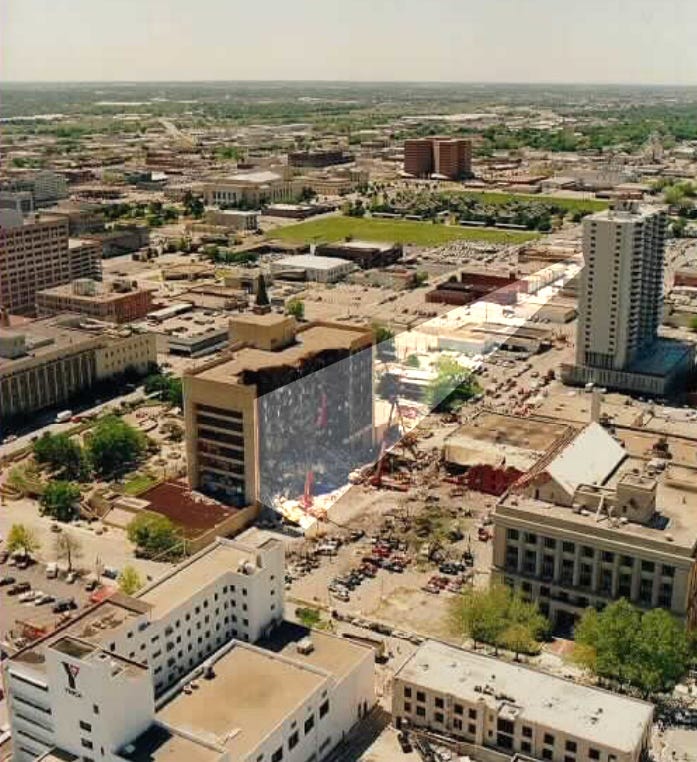
Special thanks to Jesse Trentadue and Roger Charles for contributing FBI documents and court records cited in this piece, and to Scott Horton for hosting the material on the Libertarian Institute website.
Students and researchers may access Richard’s documents and clippings on the Libertarian Institute website at https://libertarianinstitute.org/okc
This was a government operation to destroy evidence they couldn't get access to. The fact that not a single ATF employee showed up for work that day or dropped their kids at the free daycare they had there is kinda odd. All this video has been altered by now. This was a Clinton era crime cover-up.
McVeigh was a patsy - the same as Oswald. The missing mas was likely an FBI agent or plant